
Online Book Discussion | 21 September 2026 | 17:00 CEST / 11:00 EDT
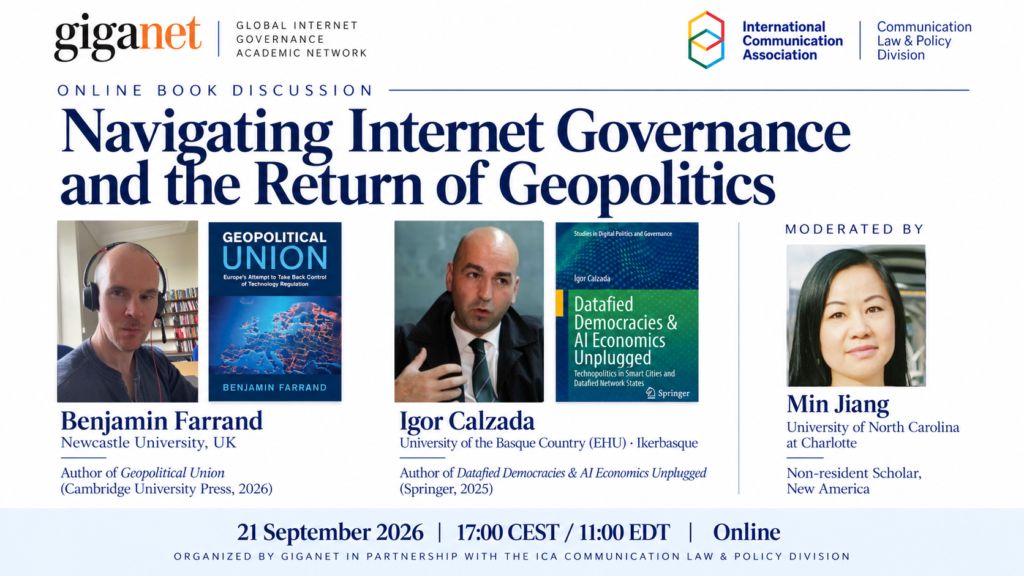
As geopolitical competition and questions of power increasingly shape the digital landscape, Internet governance stands at a critical juncture. This book discussion brings together Benjamin Farrand and Igor Calzada to discuss their recent books and what they reveal about the changing politics of Internet governance and the future of digital governance more broadly. The conversation will be moderated by Min Jiang.
Featured Books
Geopolitical Union: Europe’s Attempt to Take Back Control of Technology Regulation
Benjamin Farrand | Cambridge University Press, 2026
Geopolitical Union focuses on the changes to law and policy-making as a result of geopolitical instability and increased conflict in the international system. Central to many of these conflicts is technology – who produces it, where it is produced, and who controls it. The European Commission’s pursuit of digital/technological sovereignty is Europe’s attempt to regain control of technology regulation. Focusing on topics such as technological standards, ensuring access to microchips, and securing rules for industrial data and AI, this book explores the EU’s approach; increased regulatory oversight and promotion of industrial policy at home, while exporting its rules abroad.
Datafied Democracies & AI Economics Unplugged: Technopolitics in Smart Cities and Datafied Network States
Igor Calzada | Springer, 2025
Datafied Democracies & AI Economics Unplugged examines how AI, datafication, platform power and Web3 decentralised technologies are reshaping democracy, governance and economic life. Moving across smart cities and datafied network states, it asks whether these transformations can enable democratic renewal and anticipatory governance or deepen inequality, technocratic control and geopolitical fragmentation. The book connects AI economics with data sovereignty, data cooperatives, Web3 and digital citizenship, offering a civic and institutional framework for inclusive, accountable digital futures. For the GigaNet community, it broadens global Internet governance debates beyond infrastructure towards the political economy, territorial consequences and democratic oversight of AI-driven digital systems.
The event is organized by Giganet in partnership with the Communication Law & Policy Division of the International Communication Association (ICA).
Speakers
Benjamin Farrand is Professor of Law and Emerging Technologies at Newcastle University, UK. His research focuses on the intersections between geopolitics and technology governance, and he published Geopolitical Union: Europe’s Attempt to Take Back Control of Technology Regulation with Cambridge University Press. He has published over 30 peer-reviewed articles in journals such as the International Affairsand the Journal of European Public Policy. He is Regulation and Governance lead at the Newcastle University Centre of Research Excellence in Cybersecurity and Resilience, and a member of the CRANE cybersecurity research network.
Igor Calzada is Professor of AI Economics, Public Governance and Urban Economy at the University of the Basque Country (EHU) and Principal Investigator at Ikerbasque, the Basque Foundation for Science. His research examines how AI-driven datafication and platform power are restructuring Internet governance, digital sovereignty, democratic representation and citizenship across cities, regions and emerging network states, with particular attention to AI economics, data cooperatives and anticipatory AI governance. His international career includes research and policy appointments over the last 20 years at the University of Oxford, Cardiff University, the European Commission’s Joint Research Centre and the United Nations (UN-Habitat), alongside a US–UK Fulbright Scholar award in California. More recently, he has been just selected as an expert member of the European Commission’s Frontier AI Expert Forum and AI Act Advisory Forum. His book, Datafied Democracies & AI Economics Unplugged (Springer, 2025), advances this agenda by examining the geopolitical struggle over digital infrastructures and its consequences for democracy. His forthcoming books include Understanding AI Economics (Edward Elgar, 2026), Anticipatory AI Governance (Palgrave Macmillan, 2027), and Benchmarking City-Regions (Routledge, 2027).
Moderator
Min Jiang, Professor of Communication Studies at the University of North Carolina at Charlotte and Non-Resident Scholar at New America. She is a Secretariat member of the Chinese Internet Research Conference (CIRC) and Vice Chair of the Communication Law and Policy Division of the International Communication Association (ICA). Her work lies at the intersections of digital technology, geopolitics and policy with a focus on China and the Global South. She co-edited four special journal issues and published over 40 journal articles and chapters. She is lead editor of Digital Sovereignty in the BRICS Countries (Cambridge University Press, 2025, open access) and US-China Power Play(Michigan State University Press, forthcoming).
Event Details
Date: 21 September 2026
Time: 17:00 CEST / 11:00 EDT
Format: Online
Join the event: https://visio.numerique.gouv.fr/ffw-fwiq-bak
We look forward to welcoming you to the discussion.