Navigating Internet Governance and the Return of Geopolitics

Online Book Discussion | 21 September 2026 | 17:00 CEST / 11:00 EDT
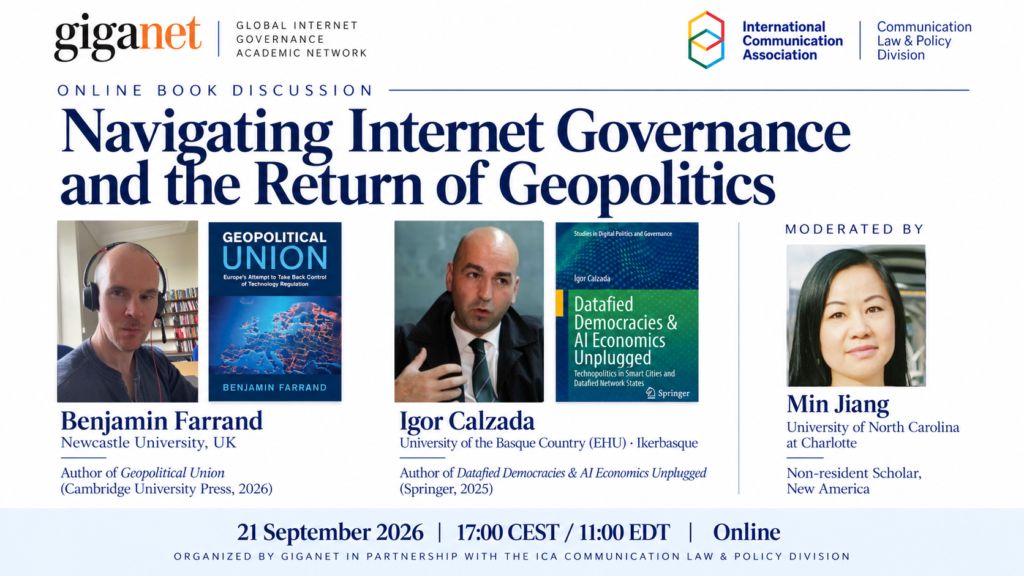
As geopolitical competition and questions of power increasingly shape the digital landscape, Internet governance stands at a critical juncture. This book discussion brings together Benjamin Farrand and Igor Calzada to discuss their recent books and what they reveal about the changing politics of Internet governance and the future of digital governance more broadly. The conversation will be moderated by Min Jiang.

Featured Books

Geopolitical Union: Europe’s Attempt to Take Back Control of Technology Regulation
Benjamin Farrand | Cambridge University Press, 2026

Geopolitical Union focuses on the changes to law and policy-making as a result of geopolitical instability and increased conflict in the international system. Central to many of these conflicts is technology – who produces it, where it is produced, and who controls it. The European Commission’s pursuit of digital/technological sovereignty is Europe’s attempt to regain control of technology regulation. Focusing on topics such as technological standards, ensuring access to microchips, and securing rules for industrial data and AI, this book explores the EU’s approach; increased regulatory oversight and promotion of industrial policy at home, while exporting its rules abroad.

Datafied Democracies & AI Economics Unplugged: Technopolitics in Smart Cities and Datafied Network States
Igor Calzada | Springer, 2025
Datafied Democracies & AI Economics Unplugged examines how AI, datafication, platform power and Web3 decentralised technologies are reshaping democracy, governance and economic life. Moving across smart cities and datafied network states, it asks whether these transformations can enable democratic renewal and anticipatory governance or deepen inequality, technocratic control and geopolitical fragmentation. The book connects AI economics with data sovereignty, data cooperatives, Web3 and digital citizenship, offering a civic and institutional framework for inclusive, accountable digital futures. For the GigaNet community, it broadens global Internet governance debates beyond infrastructure towards the political economy, territorial consequences and democratic oversight of AI-driven digital systems.

The event is organized by Giganet in partnership with the Communication Law & Policy Division of the International Communication Association (ICA).

Speakers

Benjamin Farrand is Professor of Law and Emerging Technologies at Newcastle University, UK. His research focuses on the intersections between geopolitics and technology governance, and he published Geopolitical Union: Europe’s Attempt to Take Back Control of Technology Regulation with Cambridge University Press. He has published over 30 peer-reviewed articles in journals such as the International Affairsand the Journal of European Public Policy. He is Regulation and Governance lead at the Newcastle University Centre of Research Excellence in Cybersecurity and Resilience, and a member of the CRANE cybersecurity research network.

Igor Calzada is Professor of AI Economics, Public Governance and Urban Economy at the University of the Basque Country (EHU) and Principal Investigator at Ikerbasque, the Basque Foundation for Science. His research examines how AI-driven datafication and platform power are restructuring Internet governance, digital sovereignty, democratic representation and citizenship across cities, regions and emerging network states, with particular attention to AI economics, data cooperatives and anticipatory AI governance. His international career includes research and policy appointments over the last 20 years at the University of Oxford, Cardiff University, the European Commission’s Joint Research Centre and the United Nations (UN-Habitat), alongside a US–UK Fulbright Scholar award in California. More recently, he has been just selected as an expert member of the European Commission’s Frontier AI Expert Forum and AI Act Advisory Forum. His book, Datafied Democracies & AI Economics Unplugged (Springer, 2025), advances this agenda by examining the geopolitical struggle over digital infrastructures and its consequences for democracy. His forthcoming books include Understanding AI Economics (Edward Elgar, 2026), Anticipatory AI Governance (Palgrave Macmillan, 2027), and Benchmarking City-Regions (Routledge, 2027).

Moderator

Min Jiang, Professor of Communication Studies at the University of North Carolina at Charlotte and Non-Resident Scholar at New America. She is a Secretariat member of the Chinese Internet Research Conference (CIRC) and Vice Chair of the Communication Law and Policy Division of the International Communication Association (ICA). Her work lies at the intersections of digital technology, geopolitics and policy with a focus on China and the Global South. She co-edited four special journal issues and published over 40 journal articles and chapters. She is lead editor of Digital Sovereignty in the BRICS Countries (Cambridge University Press, 2025, open access) and US-China Power Play(Michigan State University Press, forthcoming). 

Event Details

Date: 21 September 2026

Time: 17:00 CEST / 11:00 EDT

Format: Online

Join the eventhttps://visio.numerique.gouv.fr/ffw-fwiq-bak 

We look forward to welcoming you to the discussion.

2025 Symposium program announced

This year the IGF restored GigaNet’s annual symposium to its former glory, providing a full day (6 and a half hours) in a choice conference room. The GigaNet Steering Committee and its Program Chair have finalized the program for 2025. You can see the full program here.

The Symposium will be held at the Nova Spektrum conference center, Lillestrøm, Norway, June 23, 2025. GigaNet will be in Workshop Room 6.   

The program features a panel of European scholars on Low Earth Orbiting Satellites (LEOs), another panel of Europeans on multilateralism and global technology governance, three individually selected “frontier” research papers from GigaNet members, a panel discussion/debate on “Should WSIS End?” and an open mic session with the elected GigaNet steering committee members.

Attendance at the GigaNet Symposium, as always, will require registration for the UN Internet Governance Forum. Register here: https://indico.un.org/event/1016806/

Giganet Online 2024 Symposium program released

The online version of Giganet’s 2024 Annual Symposium will be held in 2025! The event, which includes 12 papers on four panels, is on February 18 and 20. The full program is shown below. All times CET (UTC-1)

February 18. 2025 Join the session here:
Access the session here: https://uva-live.zoom.us/j/83344311685

Introduction and welcome: 13:15 – 13:30

Panel 1: 13:30 – 15:00

Chair: Sophie Hoogenboom

Xiaojuan Grace Yang: A comparative study of China and EU’s digital sovereignty

Pilar Rodriguez Pita, Jorge Pérez Martínez, Alberto Urueña Lopez: “Digital Sovereignty and the Fractured Landscape of Internet Governance”

Francesca Musiani, Clément Perarnaud: “QUIC, or the battle that never was: a case of re-infrastructuring control over Internet traffic”

Discussant: Serhat Tutkal

Panel 2: 15:30 – 17:00

Chair: Sophie Hoogenboom

Discussant: Berna Akcali Gur

Hannah Ismael, Ziyaad Bhorat: Cascading Secrecy: Tensions between Transparency and Trade Secrecy

Claudiu Codreanu: Far from a consensus: Exploring the role of digital authoritarianism in hindering UN discussions on cyber norms

Dennis Redeker: Contested Governance of Speech Online: Global Perspectives on Actors in Social Media Content Moderation

February 20. 2025

Access the session here: https://uva-live.zoom.us/j/85869183170

Panel 3: 8:00 – 9.30

Chair: Jamal Shahin

Yuchao Zhao: Technopreneurial coalition vs. state-sponsored dependency: A comparison of two scenarios of digital governance in local China

Liudmila Sivetc: The Evolution of Governance by Internet Infrastructure in Russia Before and After February 2022: New Generations of Controls and Their Effects on New-School Regulation Theory

Ana Lucia Taboada, Fabiana Alvarado: Towards a genuine governance of Internet? The case of the Quechua-speaking population in Peru

Discussant: Trisha Meyer

Panel 4: 10:00 – 11:30

Chair: Jamal Shahin

Moderator: Roxana Radu

Matthias Kettemann: Uploading Tuvalu: “The Internet Governance Dimension of Virtualizing Cultural Heritage in Times of Climate Change”

Riccardo Nanni: “The shrinking online space of civil society: withstanding social control by infrastructure in war zones. The Palestine case”

Mark W. Datysgeld, Jaqueline Trevisan Pigatto, Laura Gabrieli Pereira da Silva: “Reframing Internet Governance: The Struggle of Multistakeholderism in the Face of Multilateralism”

Closing session: 11:30 – 12:00

Steering Committee elections

GigaNet will soon be launching a new round of elections for the four positions in the Steering Committee which will become available starting from next year:

   * Chair (position currently held by Roxana Radu)
   * Chair of the Program Committee (position currently held by Jamal Shahin)
   * Chair of the Membership Committee (position currently held by Berna Akcali Gur)
   * Secretary (position currently held by Clément Perarnaud). 

Descriptions of all positions and GigaNet election policies are available at: https://giga-net.org/governance/ 

All four positions have two-years mandates.

Nominations for any position should be sent to the GigaNet membership mailing list from now until December 7, 23h59 IDLW.

The Inaugural Trusted Internet Summer School on Internet Governance and International Law

The Trusted Internet Summer School on Internet Governance and International Law (SSIGIL) has recently concluded in Lodz, Poland. This fully funded, week-long event (8-12 July) was filled with insightful discussions and productive collaborations on satellite connectivity and internet governance. Hosted by the Lodz Cyber Hub (LCH) at the University of Lodz and GigaNet, this inaugural event offered the GigaNet community an exciting opportunity to explore the role of international law in Internet governance, as well as the challenges of the multistakeholder governance model.

Throughout the week, the participants approached international law, cybersecurity, Internet governance, and digital rights from the perspective of LEOs – Low Earth Orbit satellites. These satellites, used by companies like SpaceX and OneWeb, are becoming a crucial part of global Internet infrastructure, expanding connectivity in underserved and remote areas. Yet their use raises important questions about how the Internet is governed, how data is managed, and how international law applies to this new technology. The discussions at SSIGIL highlighted new developments around the world and  explored the key pillars for developing legal and governance frameworks to manage the rapid growth and impact of LEO satellite networks.

The SSIGIL program was structured around five themes, with each day kickstarting with a presentation from a leading expert in the field. These thematic sessions ensured that participants could dive deep into specific areas of Internet governance and international law, guided by the knowledge and experience of seasoned professionals.

We are especially grateful to our distinguished expert leads, whose contributions were invaluable. Their insights and guidance played a crucial role in enriching the discussions and enhancing the overall learning experience for everyone involved.

Roxana Radu – GigaNet Chair and Associate Professor at the Blavatnik School of Government, University of Oxford

Dmitry Epstein – Former GigaNet Chair and Assistant Professor at the Hebrew University of Jerusalem

Berna Akcali Gur – GigaNet Membership Committee Chair and Lecturer at Queen Mary University of London

Joanna Kulesza – CEO of LCH and Assistant. Professor of International Law, University of Lodz

Dan York – Director for Technology, Internet Society

The inaugural SSIGIL successfully brought together emerging scholars, policy and media practitioners, and established academics, emphasizing GigaNet’s pivotal role in advancing a new research agenda through collaborative efforts within its academic community and beyond.

The SSIGIL summer school was part of the “Decolonizing the Internet” research project, funded by the Internet Society Foundation’s Research Grant Program. This initiative is co-led by Joanna Kulesza, CEO of LCH and Assistant Professor of International Law at the University of Lodz, and Berna Akcali Gur, Lecturer at Queen Mary University of London. Since 2023, the project has focused on “Trust and Data Governance” within the broader theme of “Global Governance of Low Earth Orbit Satellite Broadband.”

Special thanks go to the Internet Society Foundation for their generous support, as well as to the University of Lodz for hosting. The SSIGIL summer school has deepened the discussions on satellite connectivity potential and challenges in internet governance and international law. The experiences and networks formed during the event will continuing to inspire and inform future initiatives in this space.